
Artful Dodge 54/55
Featured artist: cover art, Artist’s Statement, and Graphica portfolio
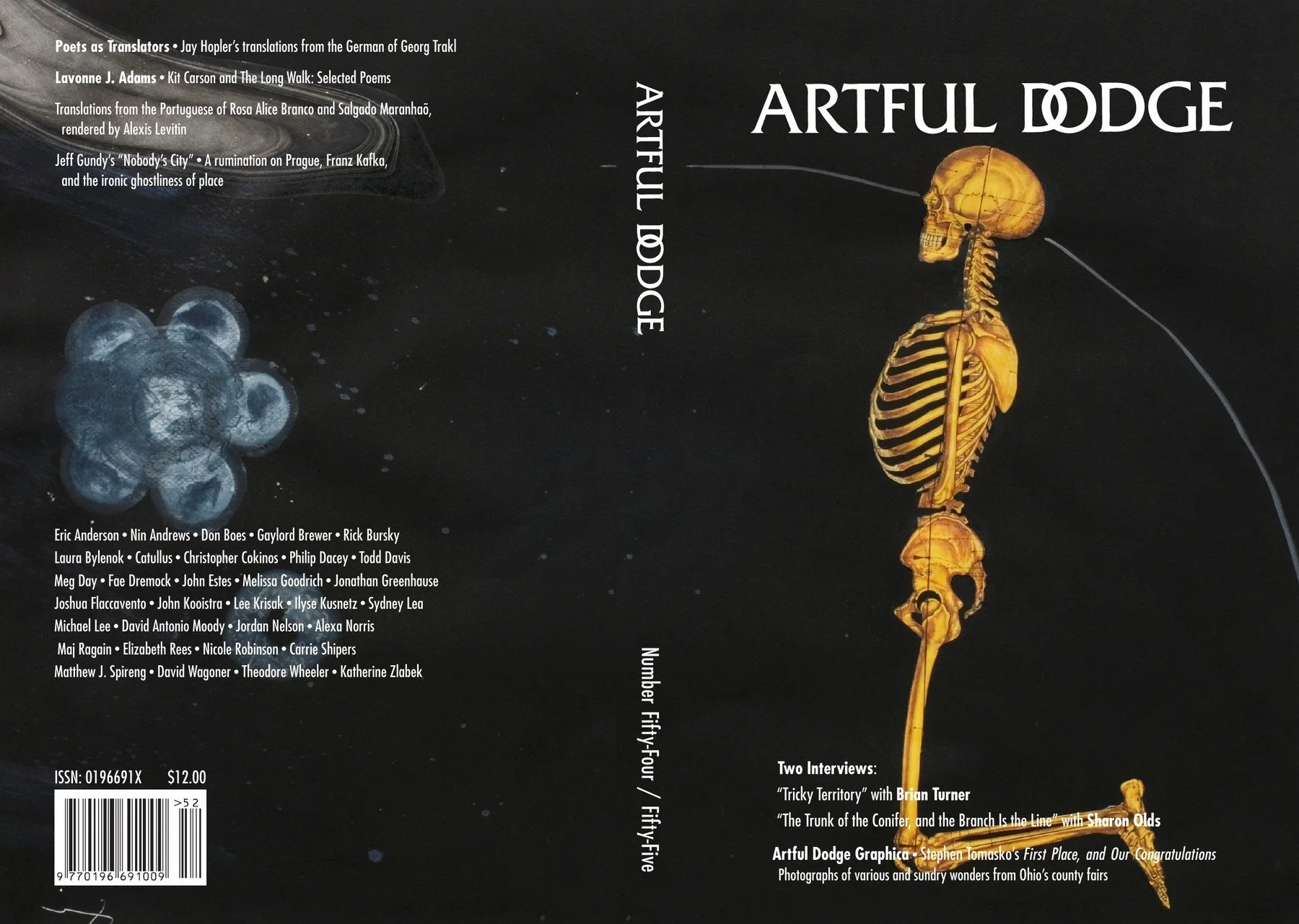
Founded in 1979 in Bloomington, Indiana, and later published at the College of Wooster, the literary magazine Artful Dodge has published Rita Dove, Czesław Miłosz, William S. Burroughs, Charles Simic, and Naomi Shihab Nye; its editor, Daniel Bourne, received the Ohioana Award for Editorial Excellence.
Contents
Poets as Translators
Graphica
Artist’s Statement
I was forty-six years old when I began to make the collage art you see here. Earlier in my life, I had trained in the literary arts at Columbia University and at City College of New York, where I studied with my long-term mentor in poetry, William Matthews. But he suddenly died when he was 55, in 1997, just when my poems were starting to get published. And, by the early 2000s, to my own grief and dismay, my work as a literary artist had lapsed into dormancy.
When I am not creatively active I feel oppressed and confined. So this was a trying time for me, one in which I felt a strong need to create but was not drawn to writing. I had a little 2×2×2 inch covered box of fine Japanese papers that I’d picked up at a tag sale years back—and I got the urge to make something with them. I was living in Boston at the time and, while I was constructing the very first collage inlay, it was good medicine. I felt myself coming back to life.
Over the months ahead, without any formal training in drawing, composition, color theory, perspective, or the like, I collected a treasure hoard of fine art papers and international currency, and bought a used set of ten flat file drawers to organize the papers according to color families.
I took classes in both Italian-style and Japanese (Suminagashi) paper marbling, which involves painting on the surface tension of water, also known as aqueous surface design. The aqueous painting is captured by slowly and carefully laying a piece of art paper down on the floating paint, lifting it off, and letting it dry. In Italian-style marbling, which most of us have seen in the inside covers of old books, oil-based inks are used and the colors are often combed into uniform, traditional patterns. Japanese Suminagashi marbling employs a similar process using water-based inks. You can also paint an abstract work of art using the same aqueous painting process—and I had a wild time in these classes, making a slew of original aqueous-design papers to use in new collage inlays.
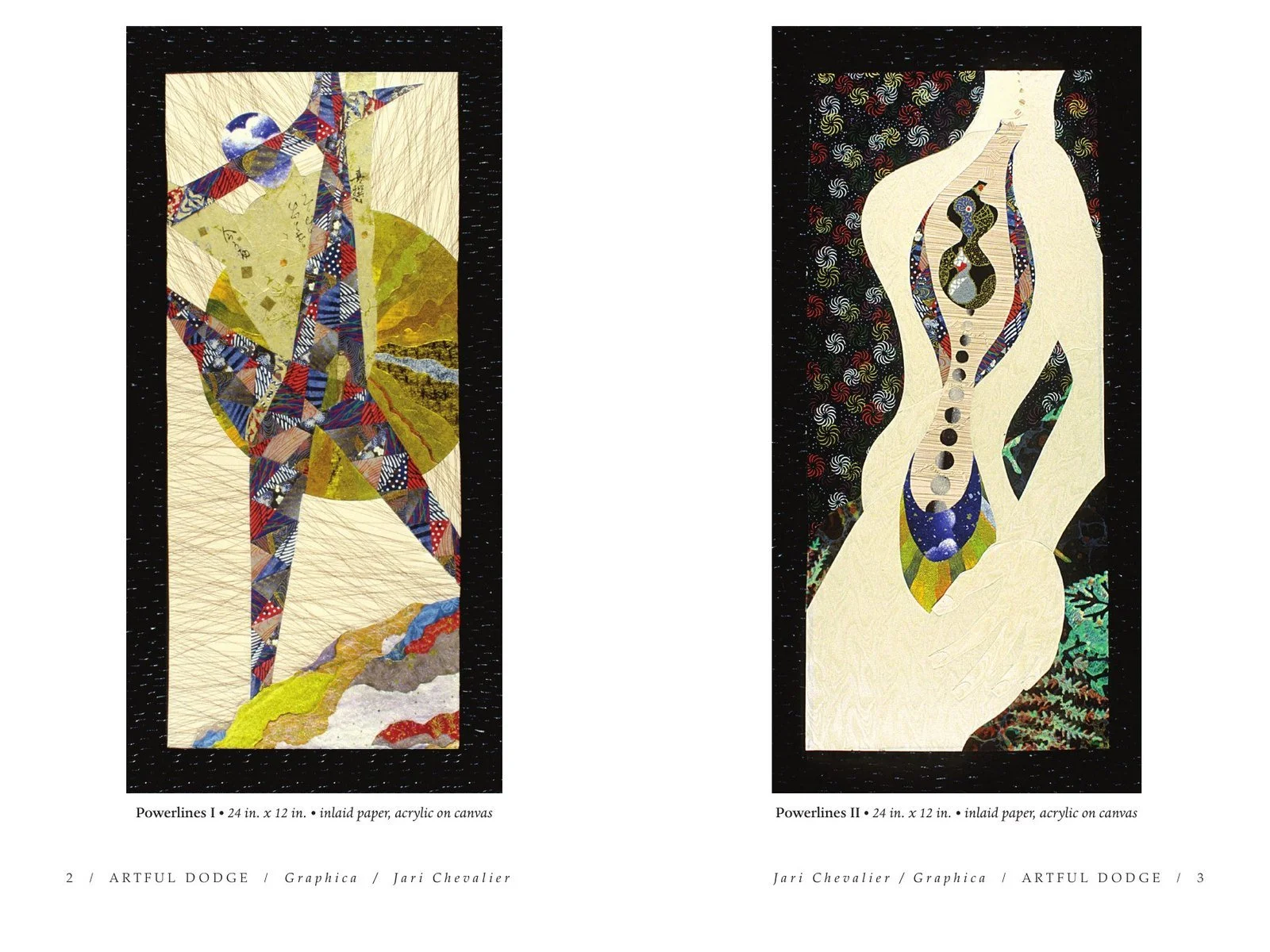
The inlay process involves sketching out the rudimentary architecture of the piece, with the largest shapes penciled directly onto the canvas or other substrate. I then use tracing paper to create each piece that’s to be cut and then inlaid with archival glue. I can see through the tracing paper to the underlying paper and thereby choose exactly where to make the cuts. If I cut out a piece of paper and for some reason don’t like the way it looks on the collage, I will either recut the piece from a different paper or modify the first piece to make it work. The final work of art thus involves countless decisions regarding form, pattern, and color as I build to a unified whole constructed of many highly disparate parts.
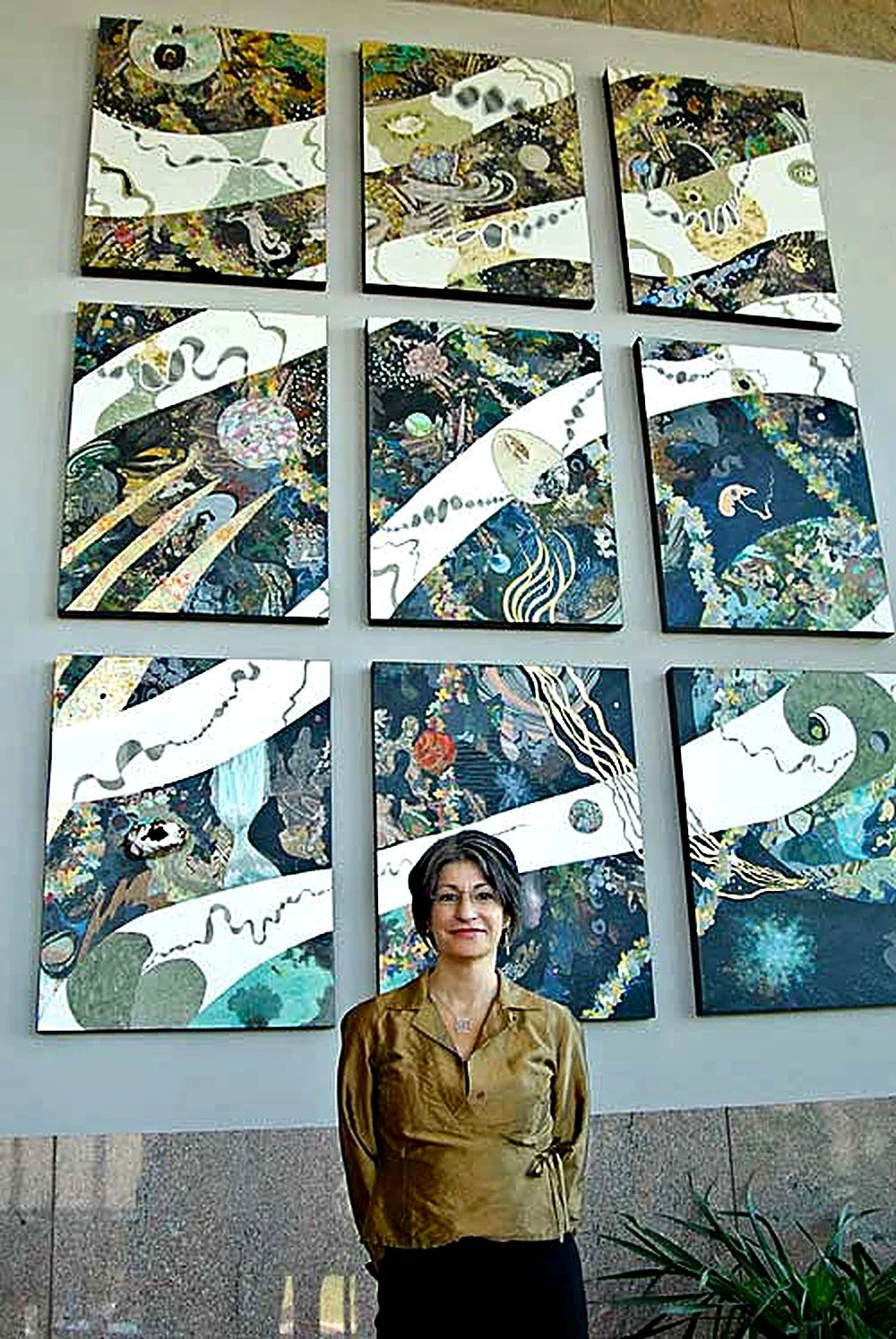
I’m fascinated with the understanding that many different patterns and forms share the same space. For example, I’m looking at the floor of my room. The irregular patterns of the wood grain keep being interrupted by the orderly pattern of the cut boards, which is again interrupted by a rug here, a mat there, another rug, or the legs and footprints of furniture. If we looked with a microscope at any one spot there would be yet other patterns (and, possibly, even creatures! dust mites, etc.), and then with an electron microscope, still more; each and all perceived through the meeting of mind and matter. The same goes for anywhere you look, a table top, the surface of your skin, the landscape. I see the world this way.
I also try to portray this kind of awareness in my art, to signal to viewers a sensitivity to multidimensional awareness that links inner space with exterior space, a holistic view of bio-psycho-social unity, of science and intuition, a vast, connected, multivalent, dynamic, and intelligent universe.
Cutting and inlaying pieces of international paper currency has, in some collages, helped in this portrayal. Such currencies will eventually become obsolete, and soon may hold greater value and significance as bits and pieces of art such as mine. Currency is an endlessly fascinating material—with its intricate, official patterns of extremely fine dots and lines, its words and numbers, its security features and potent symbols, including faces of historic significance. It is also an extremely durable paper. And double-sided. I like that the back side of any piece of currency, once glued down, is still there—and we have a record of what’s on it, though it’s hidden against the canvas.
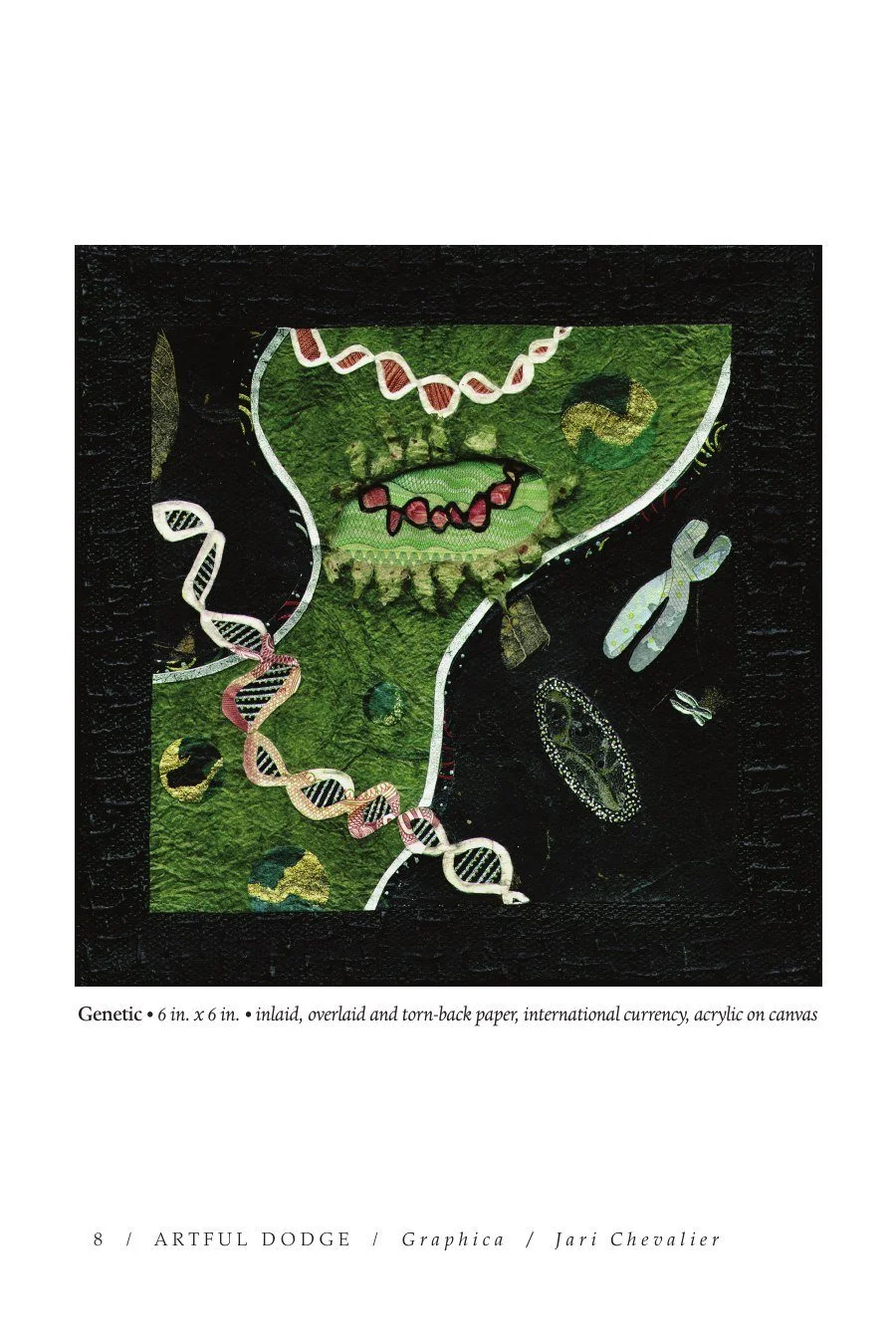
In the work “Genetic,” the chromosome forms and DNA—represented by strings of double helixes—are literally made of money. Thus, for me, the very material I used to create “Genetic” starts to pose questions: “How deep does our attraction to money go?” “Is the enterprise of science woven through and through with money?” “Have we inherited a value system from our progenitors that we pass on to our heirs?” “Is anything about central banking and the culture of money biologically encoded?” and “To what degree are our thought forms about value and worth genetically predetermined?”
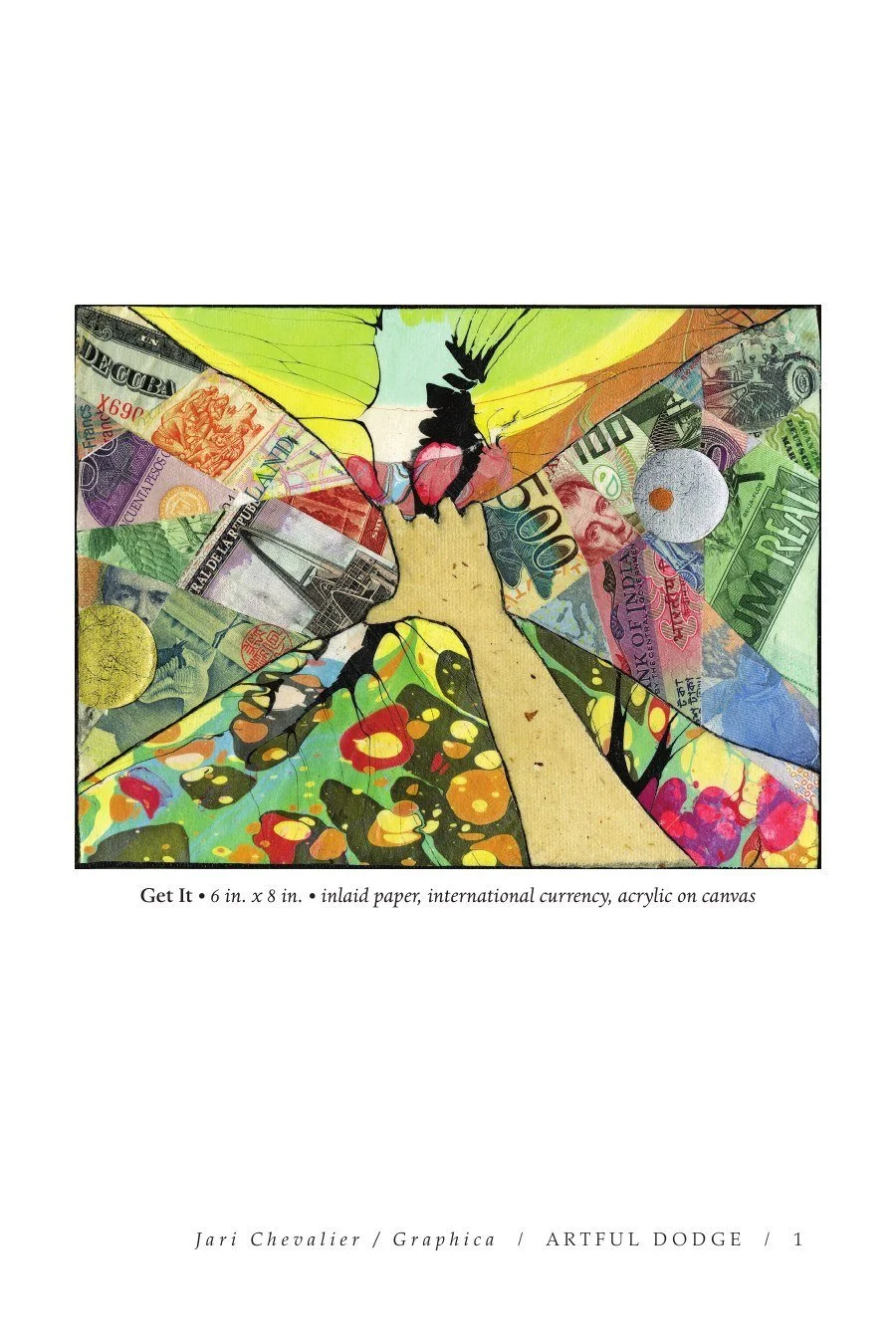
“Get It” is another collage employing international currency, inlaid with a marbled paper I made in a class. This small (6 in. × 8 in.) work depicts a hand grabbing at a geometrically structured “fabric” of world currency, including circles of metallic paper in silver, gold, and copper. But the hand’s grasping action reveals an underlying amorphous and borderless organic realm, as if the fabric has been a façade—a complex but orderly Potemkin village obscuring something more challenging, provocative, and real.
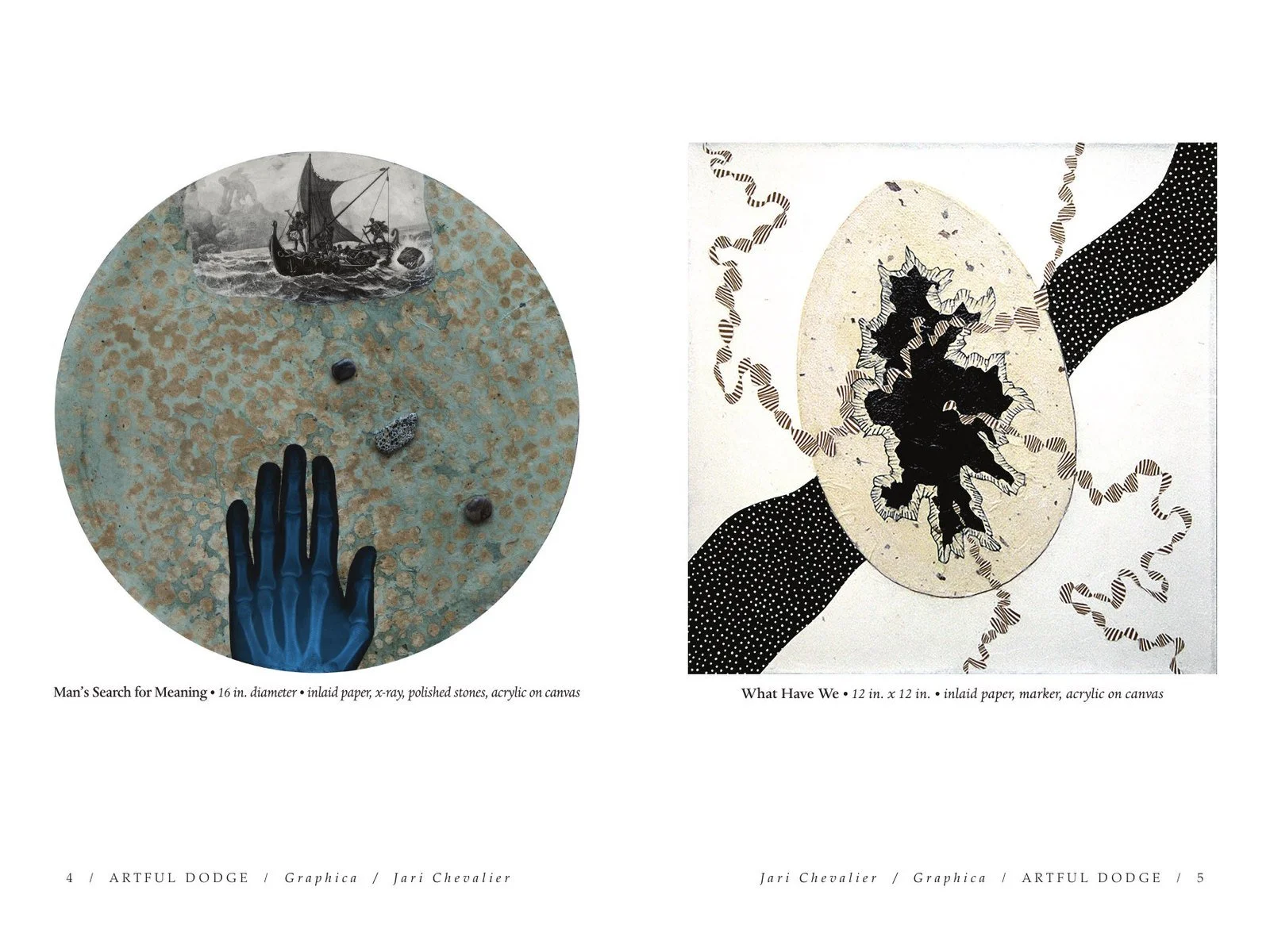
I deliberately repurpose many other materials besides currency. For example, in “Man’s Search for Meaning” I cut out the central portion of a print of Louis-Frédéric Schützenberger’s 1887 etching “Ulysses Defying the Cyclops” (found at a tag sale), made an “x-acto cut” of an x-ray film of the outlines of a hand (that a radiology student gave me), and then inlaid these with a piece of paper featuring the colors of water and stone. I purposely damaged this water-stone paper with a mix of water and glue to fix a water-bleed quality into it. Then, once the piece was dry, I added three polished stones to the collage’s surface, as though these very stones, which look wet and gleaming via the polishing tumbler, landed in this work of art all the way from the distant past of the Western psyche. Homer’s verse epic expressed through Schützenberger’s fine etching, embedded in my contemporary collage art, now in conversation with your own contemplation.
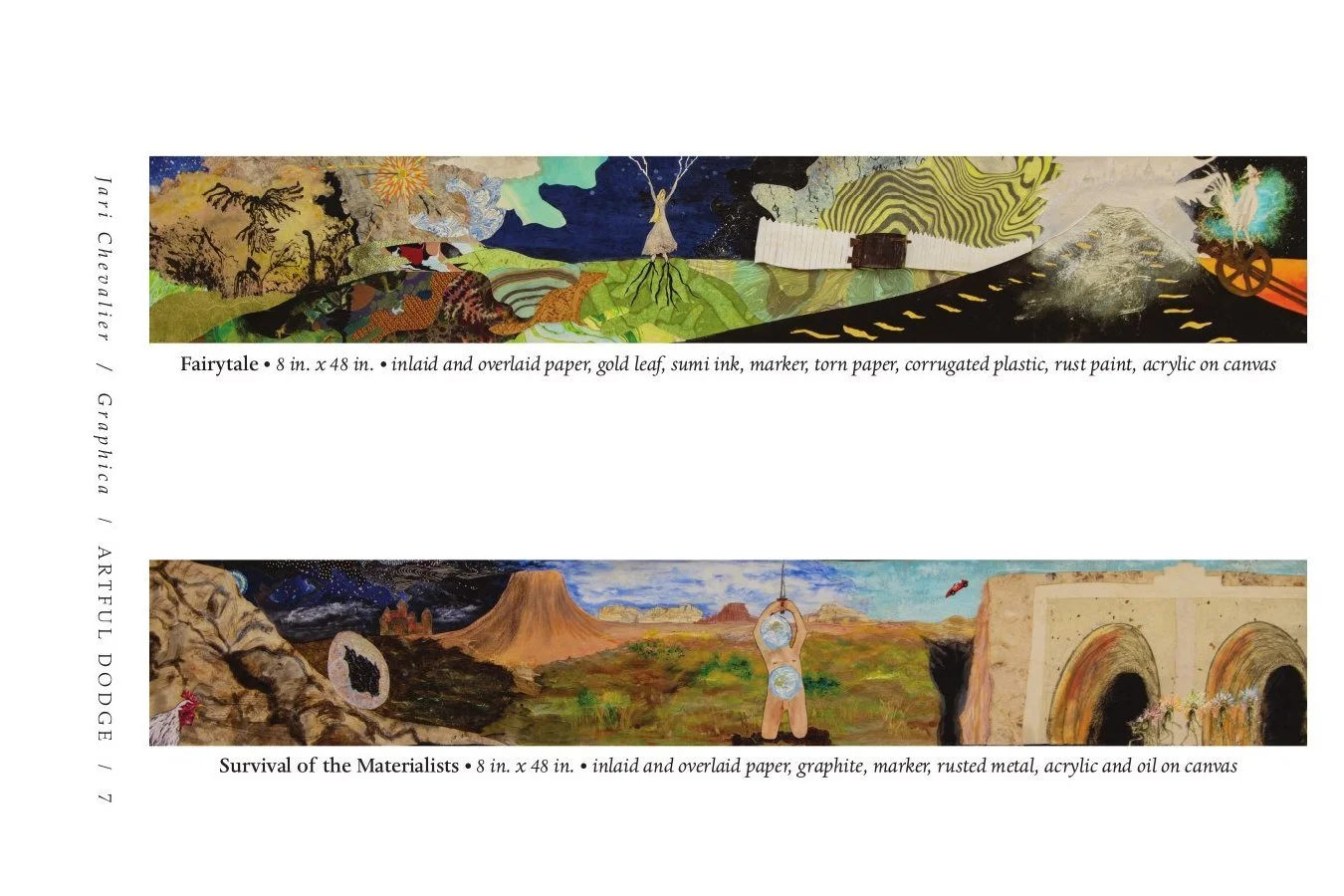
Despite all the examples of intentionality I could provide about my art, at times I have been shocked in the midst of creating something or when a work reaches completion. I literally gasped when I made the man kneeling on rusted metal to commit hara-kiri, with a globe for a head and another globe in his about-to-be-eviscerated belly (“Survival of the Materialists”). And I literally broke down and cried upon finishing “American Legacy,” a collage (not included here) depicting a mushroom cloud framed in a simulated traditional Japanese scroll painting, with the spirits of domination and submission at its center. We did that to Japan, I thought, a culture I’ve loved since, as a young child, I entered the Japanese aesthetic through my parents’ picture books showing extraordinary details of Japanese architecture set in exquisite Japanese gardens.
In my work overall, I hope you perceive this abiding Eastern sensibility and spirituality, which began in early childhood. My parents were interested in the spiritual teachings of J. Krishnamurti, a 20th-century Indian-born philosopher who called for deep inquiry into (and consistent observation of) one’s own mind and of all phenomena. He was also an influential social critic who urged people, as did the Buddha, to be a light unto themselves, to question social conditioning, and to dedicate themselves to evaluating reality through personal discovery and a rich inner life. He said, “It is no measure of health to be well-adjusted to a profoundly sick society.” His teachings appealed to the natural artist and rebel in me. They affirmed my innate proclivities and challenged me to penetrate my own conditioning, to reach inward for a more nourishing way of life and assessment of truth.
In 1988, I also began to practice meditation in the Thai Forest Tradition. In addition to a daily practice, I have sat many months in silent, monastic retreats. And as I work on art, I find myself in a similar state of mind that is highly meditative, not thinking, just doing. Despite what I might say about intention, ideas and design are mainly intuitive; some arise before the first marks are made, others only as the work develops. My art happens to me, and I am in awe that this is so.
—Bristol, Vermont, August 1, 2018